The Intersectionality Paradox: Why leaders know it matters but struggle to put it into practice
As a leader of a team, how do you operationalise intersectionality in team discussions and decision-making?
“It’s all about intersectionality these days, but I don’t even know what it is!” - expressed an exasperated leader recently.

The Historical Roots of Intersectionality
Once primarily associated with legal scholarship and critical social theory, Intersectionality is now firmly embedded in the language of diversity, equity, inclusion and belonging (DEIB).
Whilst it has deservedly highlighted a more nuanced understanding of identity, in particular the cumulative impact of multiple marginalised identities, how does a time poor leader, operationalise this in a team setting?
While organisations increasingly acknowledge the importance of intersectionality, and some are translating this insight into policies, metrics and reporting frameworks, it remains challenging to translate into everyday team decision-making, which is where the diversity dividend delivers.
This is the intersectionality paradox: the more we recognise the complexity of human identity, the harder it becomes to design systems capable of addressing it.
Or might we need to think differently?
What is Intersectionality?
Intersectionality was first articulated by legal scholar Kimberlé Crenshaw (1989), who examined how Black women experienced discrimination at the intersection of race and gender. She argued that anti-discrimination frameworks often forced people to fit into single categories of disadvantage, eg. race or gender, thereby overlooking experiences that were distinctively intersectional.
Crenshaw's analysis of the DeGraffenreid v General Motors case in the US, revealed that Black women face a unique form of discrimination that could not be adequately understood through separate analyses of racism and sexism. In other words, their experiences were not additive, they were substantively different.
Since then, intersectionality has expanded beyond race and gender to include disability, sexuality, age, religion, socioeconomic status, cultural background and many other dimensions of identity. Contemporary DEIB practice increasingly acknowledges that individuals simultaneously occupy multiple social positions that may provide privilege and disadvantage, depending on context.
The appeal of intersectionality is straightforward: people are more than a single demographic category.
Why Intersectionality Matters
An individual’s lived experience is shaped not by one aspect of identity but by the interaction of many. For example, awoman may be culturally diverse; a man, neurodivergent; an older worker, a caregiver. A First Nations person may also identify as LGBTQIA+ and live in a regional community. There are an infinite number of possibilities.
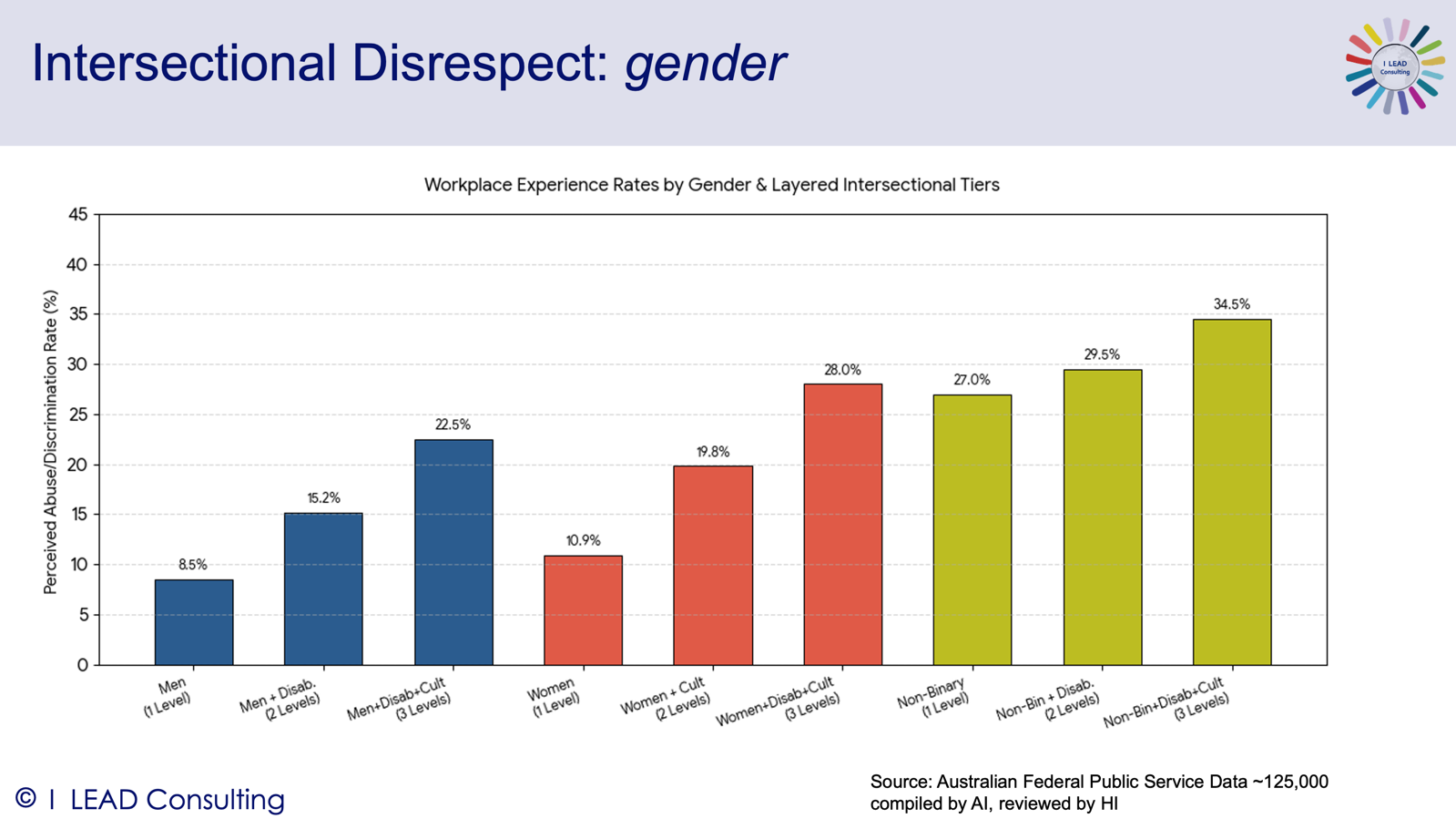
Research consistently demonstrates that these intersections influence workforce experiences across the employee lifecycle, as well as an individual’s lived experiences through team interactions. Identity-based employee data consistently shows significant variations in inclusion and engagement outcomes across different demographic groups, indicating that workplace experiences are not evenly distributed.
The data below from the Australian Federal Public Sector, confirms an individual’s experiences are increasingly magnified with each additional layer of disadvantage.
Questions quickly emerge:
What happens when one employee belongs to multiple underrepresented categories?
How should overlapping forms of disadvantage be assessed?
How are advantage and disadvantage reconciled?
How do organisations avoid creating competition between groups?
These questions rarely have simple answers. As a result, many leaders default to familiar stereotypes and singular demographic focused solutions, rather than attempting more sophisticated intersectional solutions. What does it mean for leaders, however, during team discussions and decision-making?
For organisations seeking fair and inclusive workplaces, ignoring these intersections risks designing initiatives and team experiences, that benefit some groups, while inadvertently overlooking others.
Structural and Systemic Challenges
Acknowledging intersectionality is considerably easier than implementing it.
Measurement Becomes Exponentially More Complex
Most organisations are relatively comfortable measuring single demographic variables such as gender or age. Considering multiple identities simultaneously, however, increases the analytical challenges.
For example, an organisation may have sufficient data to examine women's promotion rates. However, can it reliably analyse outcomes for:
First Nations women?
Women with disabilities?
Older, culturally diverse women?
LGBTQIA+ women in leadership?
In addition to the availability and analytical mechanisms, as categories multiply, sample sizes shrink. Statistical reliability decreases, and privacy concerns increase. Organisations often find themselves caught between wanting richer insights and lacking sufficient information and volumes of data to generate meaningful conclusions.

Existing Systems were Built around Single Identities
Most DEIB policies, reporting frameworks and legislative requirements were developed using unitary approaches to enabling diversity and equity. For example, organisations frequently establish separate initiatives for gender, disability, cultural diversity or LGBTQIA+ inclusion.
This is understandable because regulatory frameworks, benchmarking systems and reporting obligations are often organised in that manner. It is also somewhat pragmatic, given the infinite array of variables.
Team members, however, don’t contribute to team discussions and decisions, based on their identities residing in separate compartments.
The Tension Between Simplicity and Accuracy
Perhaps the greatest challenge in navigating intersectionality is the ability to balance simplicity with accuracy.
On the one hand, single-category approaches are easier to measure, communicate and govern. They allow organisations to establish targets, develop programs and report progress, with relative ease. On the other hand, intersectional approaches are more accurate because they better reflect lived experience.
Moving Beyond the Paradox
Shift from viewing intersectionality as a reporting exercise, to viewing it as a leadership lens.
Several practical approaches can help:
Listen Beyond Labels
Whilst quantitative dashboards reveal patterns, qualitative data reveals experiences. An organisation, for example, may discover that employees with multiple intersectional identities consistently report lower wellbeing and belonging scores
The dashboard establishes that a disparity exists. However, interviews and focus groups may reveal the underlying causes: fragmented support systems, exclusion from influential networks, invisible disabilities, or pressure to navigate competing identity expectations.
Together, quantitative and qualitative data provide a more complete picture, with the quantitative data identifying whereinequities occur, and the qualitative detail explaining why.
For example, a dashboard might confirm that "Flexible work increases wellbeing”. Intersectionality emerges at the point where those two forms of insight meet. Together, they enable leaders to design flexibility policies that are not only popular, but genuinely inclusive.
For example, a traditional flexibility policy documents how we support working parents; whereas an intersectional flexibility policy asks, "What barriers prevent anyone, anywhere, anytime from performing, belonging and thriving, and how can flexibility help remove them?"
Adopt an "Emic" Perspective
Tatli and Ozbilgin argue for an emic approach that asks how advantage and disadvantage are experienced within a specific context. This differs to the “identity first approach’, which attempts to predefine categories which explain every outcome.
Instead of asking, "What are women’s experiences in our team?" leaders might ask:
"What forms of advantage and disadvantage exist in this organisation, and who experiences them?"
Design Inclusive Systems Rather Than Identity-Specific Solutions
Universal design principles can reduce barriers for many groups simultaneously. A few common examples of this include accessible technology, transparent promotion processes and psychologically safe cultures, however, it’s important to continue monitoring both the quantitative and qualitative data, to ensure that more privileged identities, aren’t inadvertently benefiting disproportionately.
Focus on Belonging
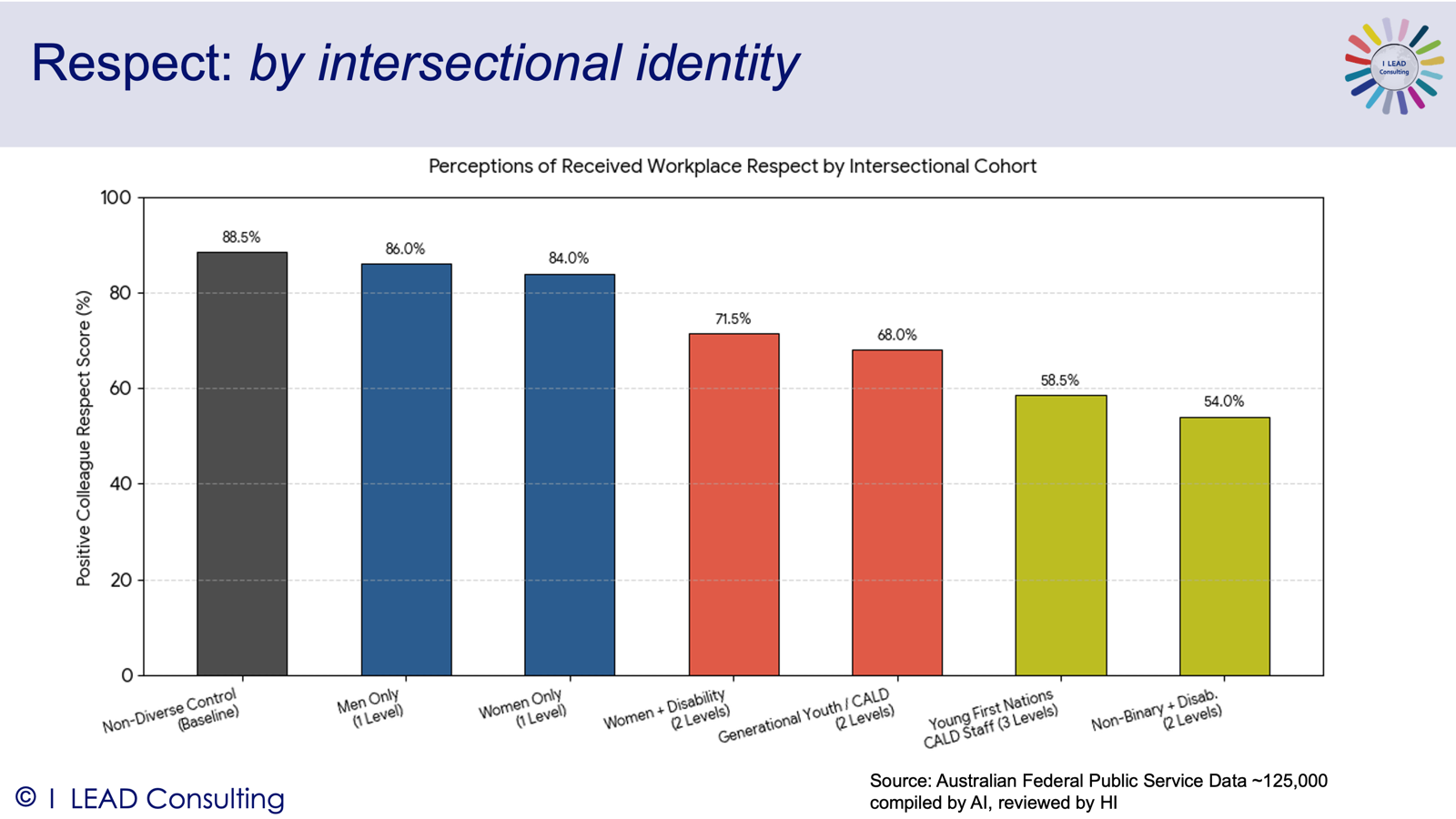
Intersectionality reminds leaders that identity influences whether people feel seen, respected and valued. Creating cultures of belonging for individuals, are likely to have a greater impact than attempting to build increasingly complex demographic categories.
Intersectional Interpersonal Interactions
Many organisations measure interpersonal inclusion by asking whether everyone has an opportunity to participate. Intersectionality challenges shortcuts such as Gen Z want X, Women need Y.
AI meeting analysis, which reflects the quantity and quality of team member contributions, can provide surprising insights.
Leaders Fear Getting It Wrong
The uncertainty and ambiguity of intersectionality can be unsettling, which often results in leaders failing to acknowledge the impact of identity in team discussions and decisions. Naturally this perpetuates existing inequities.
A universal design approach suggests asking different questions:
Whose voices and viewpoints are respected?”
How are workplace experiences different within the team?
Whose ideas actually influence decisions?
Replace Assumptions with Curiosity
Whose voices are missing?
Who benefits from current practices?
Who might be unintentionally disadvantaged?
Build a habit of asking "for whom does this work?"
Practical Questions for Leaders
Who speaks most often?
Who gets interrupted?
Whose ideas receive support?
Who receives credit?
Who challenges decisions?
Whose perspectives are absent?
Are we confusing confidence with expertise?
What Good Intersectional Interactions Look Like
Intentionally create opportunities for all voices to influence outcomes by:
manage interruptions
acknowledge idea ownership
encourage constructive disagreement
offer multiple ways to contribute (verbal, written, asynchronous)
evaluate decisions based on the quality of ideas, not the status of the speaker
Final Thoughts
Intersectionality has fundamentally changed how we understand workplace inclusion. It challenges simplistic assumptions about identity, and highlights the reality that people experience organisations through multiple, intersecting dimensions of self.
However, the very strength of intersectionality i.e. its capacity to illuminate human complexity, also has the potential to make it more challenging to operationalise.
Intersectionality is less about creating precise labels, and more about asking better questions i.e. questions that help organisations see people as they really are: complex, multidimensional and impossible to reduce to a single label. This requires humility, curiosity and systems-thinking, to support the individual needs, of all individuals, everywhere.

At I LEAD Consulting we’re on a mission to bring us all together and simplify Diversity and Inclusion for Leaders and Teams.
PRACTICE INCLUSION | EMBRACE DIVERSITY | ACTIVATE ALLIES